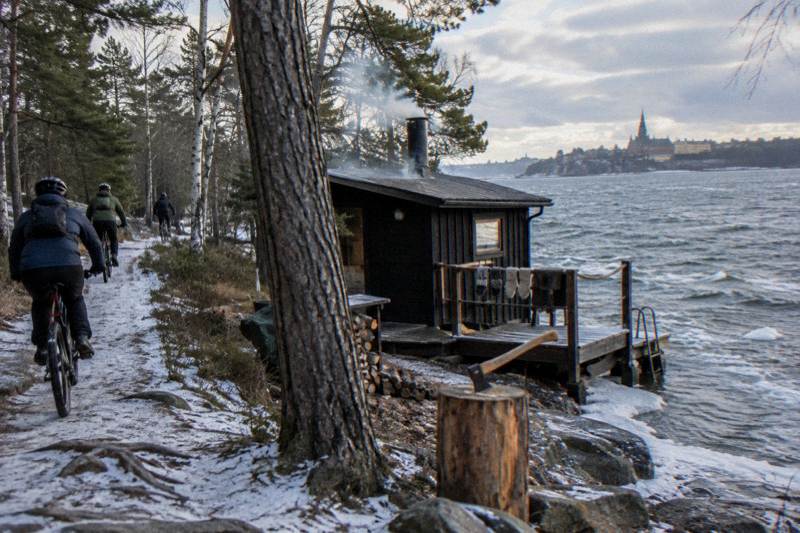
Cycling The Stockholm Archipelago By Ferry And Bike
The Stockholm archipelago stretches east of the city across tens of inhabited islands, and several of them are reachable with a bike on a scheduled ferry. Here is what a realistic ferry-and-bike day involves, what the rules are, and where a guided ride earns its keep.
Short answer
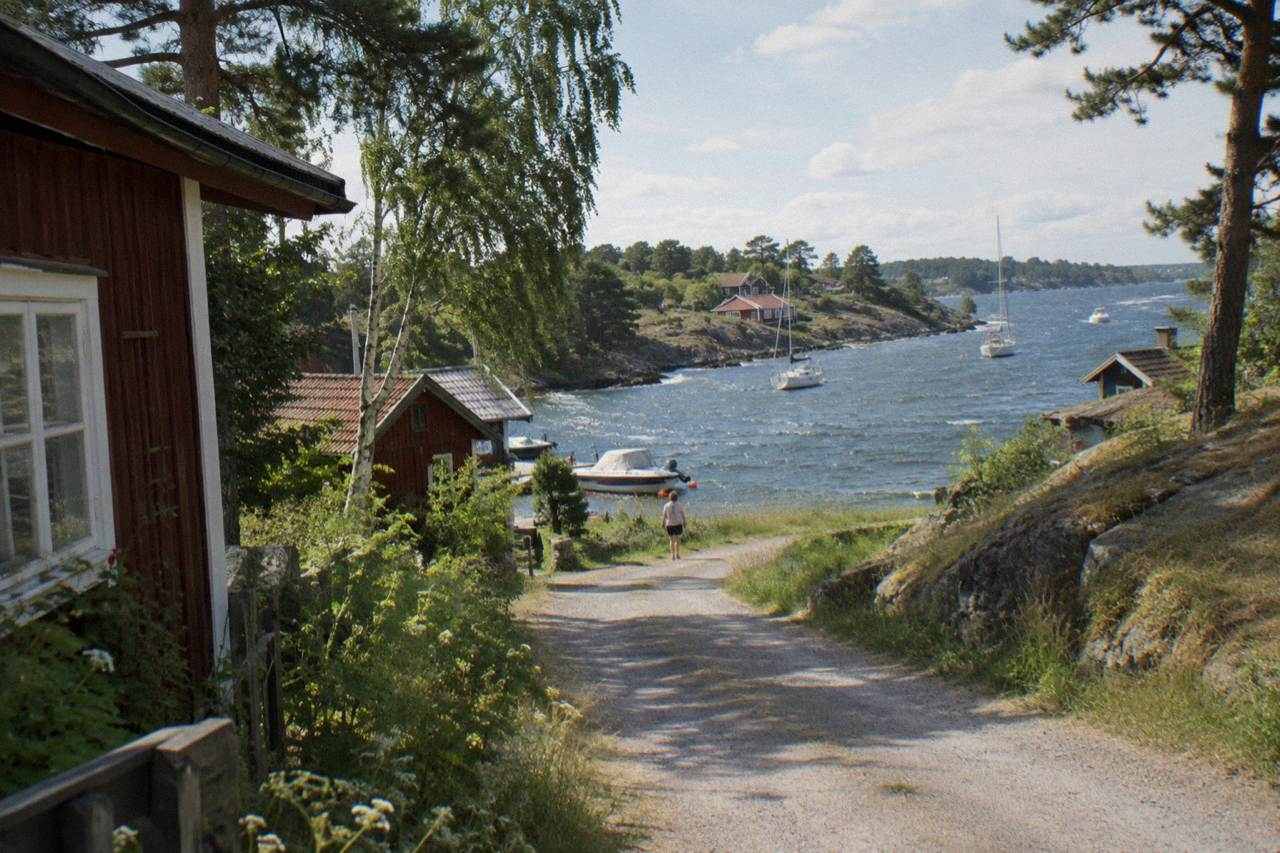
Yes, you can cycle the Stockholm archipelago, but not as one continuous ride: you island-hop by ferry and ride each island's roads and lanes. Packaged cycling holidays run roughly mid-May to mid-September, a 5-night archipelago adventure costs from 9,375 SEK per person, and standard bikes travel free on SL commuter boats and Waxholmsbolaget ferries subject to space.
The Stockholm archipelago is one of the largest island clusters in the Baltic, and the city sits at its western edge. That geography is the whole reason ferry-and-bike travel works here: scheduled boats leave from central quays and, within an hour or two, you are pedalling a pine-scented island road with the harbour noise behind you. This Stockholm Bike Tours guide looks at what is genuinely realistic on an archipelago cycling trip, what the packaged holidays actually contain, and where a guided ride in the city itself fits into the plan.
Can You Cycle The Stockholm Archipelago?
Yes, but not as a single continuous route. The archipelago is a ferry-and-bike destination: you ride each island's roads, then take a scheduled boat to the next one. Specialist operators sell self-guided packages covering roughly 220 km over five riding days, priced per person in seasonal bands, while independent travellers can piece together day trips using public commuter boats and Waxholmsbolaget ferries with a normal bike at no extra charge.
The word "cycling" in "stockholm archipelago cycling" misleads people. There is no continuous land route; the islands are separated by open water, so every itinerary is a chain of rides stitched together by boat. The packaged holidays embrace this. One operator's self-guided archipelago trip covers roughly 220 km over five riding days with daily departures through the season, and its 2027 season runs on the same mid-May to mid-September window as 2026. Another runs a guided adventure package over five nights from 9,375 SEK per person, with fixed summer departure dates.
What you ride on the islands varies. Some islands have quiet asphalt lanes, others gravel forest tracks, and the packaged operators assume a reasonably sturdy bike rather than a thin-tyred road racer. The Stadiongirot event in the city, for comparison, explicitly bars thin-tired road bikes on its gravel-and-trail laps through the royal park, which tells you something about the surfaces this coast favours.
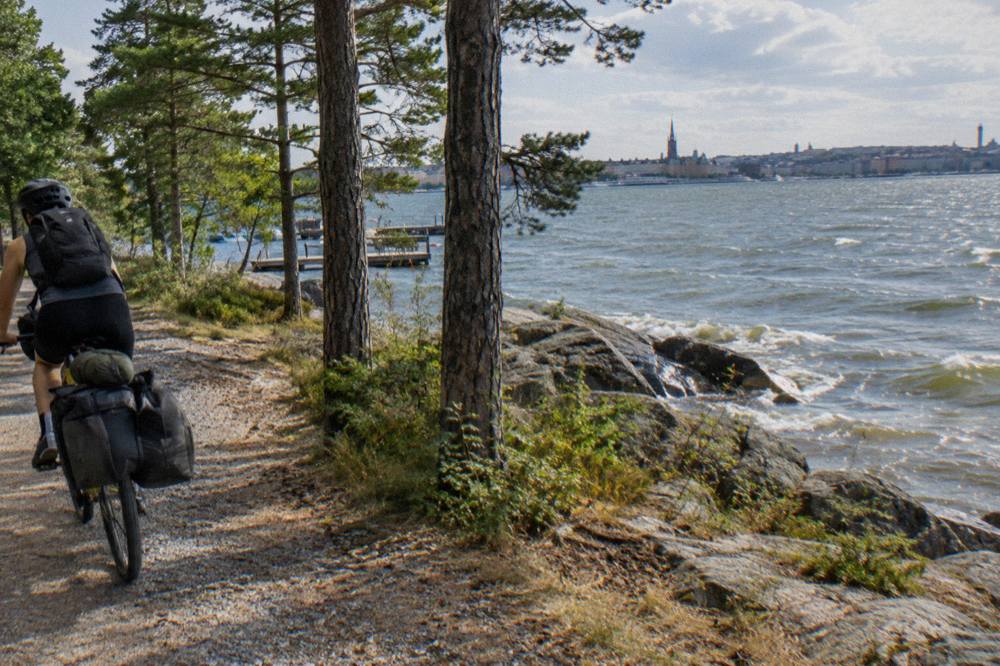
For most visitors the honest answer is a tiered one. A one-day taste by commuter ferry is very doable on your own. A multi-island loop with luggage is where a packaged or guided product starts earning its price, because ferry timetables, beds and dinner reservations on small islands are genuinely awkward to coordinate from abroad. Our overview of seasons and daylight for riding covers the weather half of that decision.
Which Islands Can You Reach With A Bike?
The realistic day-trip islands are the inner ones on SL commuter boat lines, where a standard bike travels at no extra cost subject to space, and Waxholmsbolaget boats reach the middle archipelago with the same one-bike-per-person rule. Package operators publish full island chains, typically five riding days across the middle archipelago, but none of the operators or official pages state riding distances per island, so plan on time rather than kilometre totals.
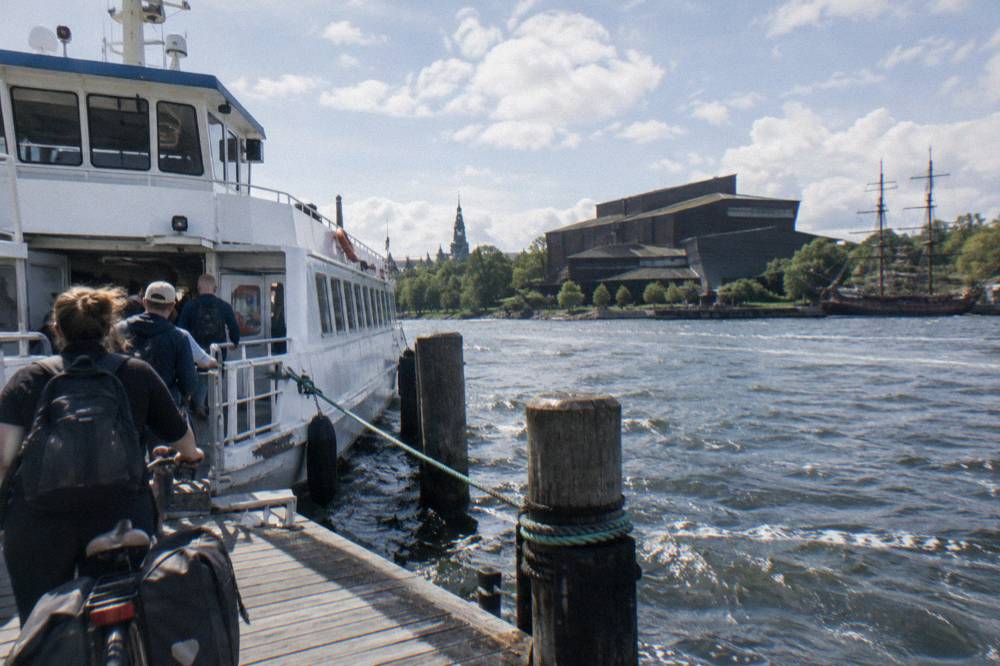
Two boat systems matter. The SL commuter boats, including the year-round Djurgården ferry (line 82), take a regular bike at no extra charge when there is space, and staff have the final say on crowding. Waxholmsbolaget's archipelago boats allow one regular bike per person if space allows, also at no extra charge; cargo bikes, tandems and other bulky bikes are carried as goods for 120 SEK, and e-bikes must stand on deck. Those are the two doors from the city into rideable islands.
The packaged itineraries tell you which islands the operators themselves consider rideable in sequence. Both the self-guided and the guided five-day products run through the middle archipelago with ferry hops between islands, and one operator's guided package lists its 2026 departures across late June, July and early August. That midsummer concentration is not marketing: it is the window when island accommodations, ferries and cafés are all running at full schedule. For help weighing a guided tour against going on your own, the practical comparison of ways to see the Stockholm archipelago covers seasons, boat rules and planning in a single place.
| Way in | What it is | Bike rule | Best for |
|---|---|---|---|
| SL commuter boats, including the Djurgården ferry | Public ferry lines in the city and inner archipelago | Regular bike at no extra cost, space permitting, staff decide | Short city-to-island hops, same-day returns |
| Waxholmsbolaget boats | Scheduled archipelago ferries to the middle and outer islands | One regular bike per person free if space allows; bulky bikes 120 SEK as goods; e-bikes on deck | Full day trips and island chains |
| Packaged cycling holidays | Self-guided or guided multi-day trips, roughly mid-May to mid-September | Bike usually included or arranged by the operator | Multi-island itineraries with luggage and beds handled |
| Guided day rides from Stockholm | Guided tours in and around the city, boat legs optional | Bike and helmet per the listing | Riders who want structure before going independent |
If you are weighing a do-it-yourself day against a packaged week, the planning piece in the archipelago by boat and bike breaks down the trade-offs from a sightseeing angle rather than a cycling one.
Do You Need A Guide For An Archipelago Ride?
For the inner islands, no: signage, ferries and quiet roads make independent riding straightforward, and the city's own network of about 1,170 km of cycleways gives you a safe run to the quays. For middle-archipelago chains or a first visit, a guided or packaged product removes the two real friction points, ferry timing and island logistics, and a guided city ride first is the cheapest way to calibrate distances before committing.
Guides are not about navigation ability. The islands are small and the roads few; you will not get lost in any serious way. What you get from a guide or a package is local knowledge of which ferry connection actually works with your riding pace, where lunch exists at all, and what to do when a boat is full. On small islands the margin between a good day and a missed connection is one departure.
The city-guided option deserves a mention here because it solves a specific calibration problem. A 3-hour guided city ride, such as the Stockholm 3-Hour Private Guided Bike Tour, priced per group, teaches you the bike infrastructure, the riding culture and your own comfortable pace before you set out island-hopping alone. A shared alternative like the Stockholm: Guided Bike Tour covers similar ground in a group format; check the booking page for each listing's inclusions and meeting point details.
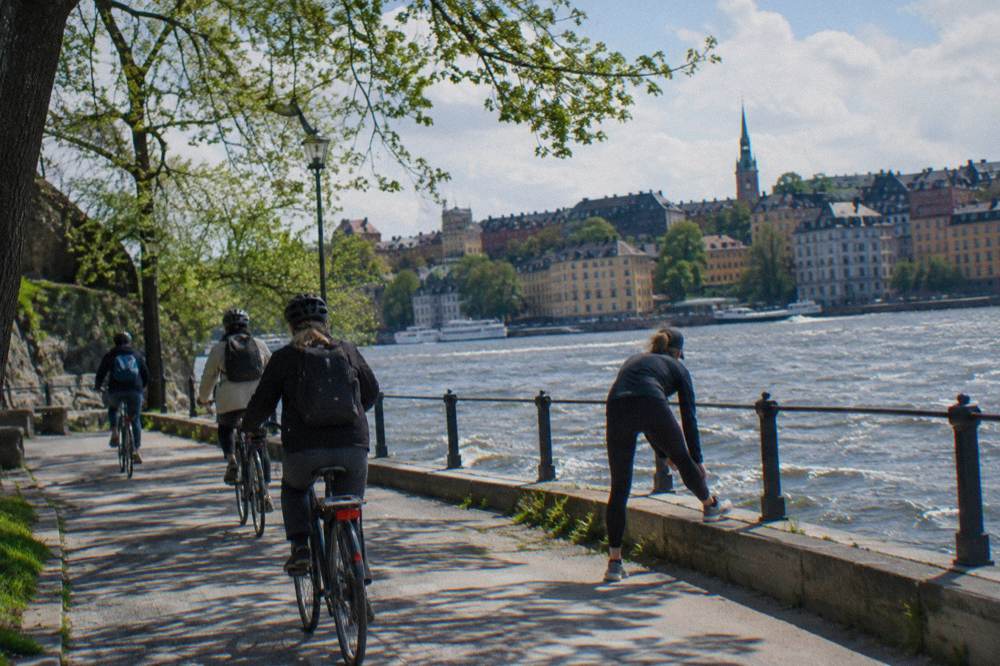
There is also a halfway option that skips ferries entirely: forest riding on the mainland edge of the same ecosystem. The Stockholm: Forest Bike Tour with Sauna and Homemade Lunch runs five hours through forest trails with a sauna and a home-cooked meal built in, which is the archipelago's texture, pine, granite and water, without the boat logistics. For riders whose real goal is nature rather than islands, that is often the better buy, and the comparison piece on guided versus independent city riding works the same logic for the streets.
What Does A Ferry-And-Bike Day Actually Look Like?
A realistic day is one boat out, one island loop, and one boat back: ride to a central quay in the morning, cross by scheduled ferry, ride the island's lanes for a few hours with a long lunch, and return on an afternoon or early-evening sailing. Two ferry hops in a day is tight once bike space is granted first-come. No operator or ferry page states crossing times, so verify each sailing on the operator's timetable.
The shape of the day is dictated by boats, not by legs. You are aiming for a loop rather than a point-to-point ride, because the ferry back usually leaves from where you arrived. Island shops and cafés are seasonal: the full-service window is the same mid-May to mid-September band the packaged holidays use, and outside it you should assume nothing is open and carry your own food.
Two practical limits shape the plan. First, bikes board subject to space and staff judgement on both SL boats and Waxholmsbolaget, so arrive early for popular sailings. Second, you cannot bail out mid-island by other means: standard bikes are not allowed on SL buses, the metro or trams, so a bike-day plan has no rail fallback once you are across the water. Commuter trains and commuter boats are the only rolling options for a full-size bike, with limits.
When Is The Archipelago Cycling Season?
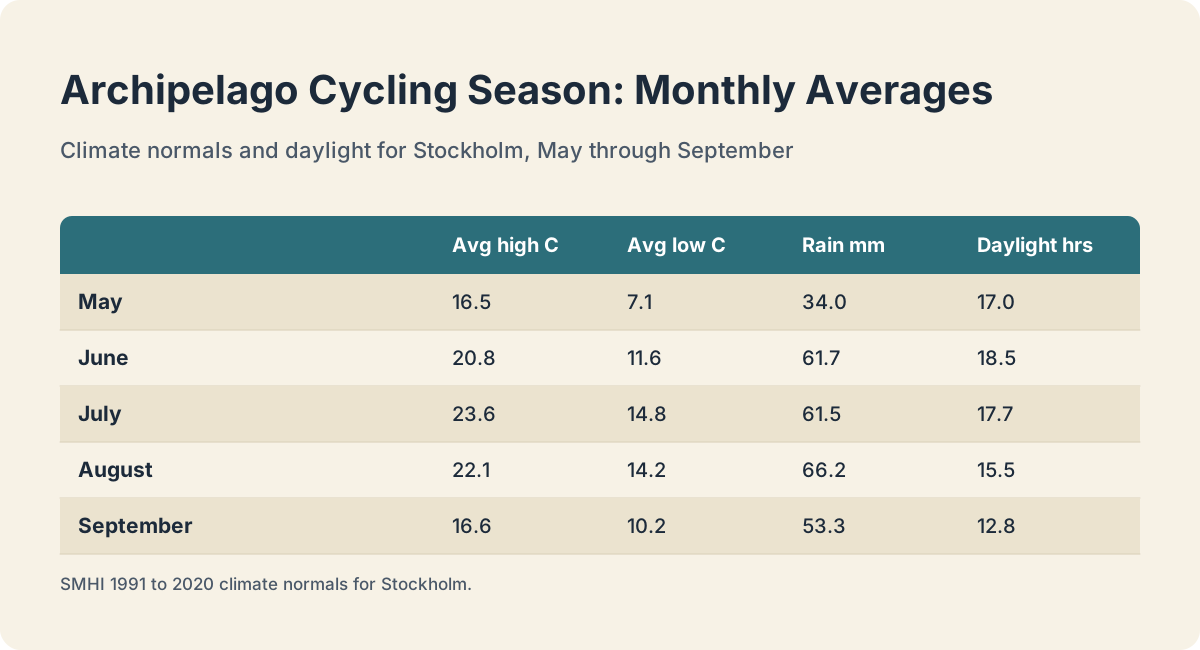
Mid-May to mid-September, matching the packaged operators' own calendars, with the best combination of warmth and long days from late May through August. Stockholm's July normals average about 23.6 C highs against lows near 14.8 C, June delivers roughly 18.5 hours of daylight, and August is the wettest month at around 66 mm of rain, so July is warmest while June and September trade a few degrees for thinner crowds.
The operators vote with their calendars. The self-guided archipelago holiday runs daily from mid-May to mid-September in both 2026 and 2027, the guided adventure package runs fixed departures from late June to early August, and the seasonal rental shops that equip independent riders run similar windows. Before mid-May you are riding on reduced ferry schedules with cold water on both sides of you.
The numbers behind that calendar come from the SMHI 1991 to 2020 normals for Stockholm, which describe a typical year rather than any forecast. They matter here because island riding exposes you to wind off open water, and the wettest summer months deserve respect.
| Month | Avg high C | Avg low C | Precip mm | Daylight hours per day | Archipelago riding |
|---|---|---|---|---|---|
| May | 16.5 | 7.1 | 34.0 | 17.0 | Season opens mid-month |
| June | 20.8 | 11.6 | 61.7 | 18.5 | Peak light, package departures begin |
| July | 23.6 | 14.8 | 61.5 | 17.7 | Warmest month, peak crowds |
| August | 22.1 | 14.2 | 66.2 | 15.5 | Wettest month, full schedules hold |
| September | 16.6 | 10.2 | 53.3 | 12.8 | Season closes mid-month |
Riders who want to extend the idea into colder months do have company: winter e-bike guided tours in Stockholm run with winter tyres and gear provided, and fat-bike forest rides with sauna and lunch run year-round on the mainland. Neither is an archipelago crossing, but both keep the water-adjacent riding habit alive between seasons.
What Are The Rules For Taking A Bike On Swedish Ferries?
On SL commuter boats, including the Djurgården ferry, a regular bike costs nothing extra and boards subject to space, with staff making the final call. On Waxholmsbolaget, one regular bike per person is free if space allows, bulky bikes are carried as goods for 120 SEK, and e-bikes must be placed on deck. E-scooters are banned from the metro entirely, and charging any lithium vehicle on board is banned across SL services.
These are the rules that make or break a plan, so they are worth having exactly right. The SL rules on bikes are strict on land and generous on water: full-size bikes never ride SL buses, the metro or the city's trams, but commuter trains, some light-rail lines and the commuter boats take them, with limitations and staff discretion at the edges. The Djurgården ferry, the one most visitors meet first, is a commuter boat, and bikes board free there too, which is why pairing a Djurgården ride with a crossing works so well; our Djurgården riding guide covers the island end of that trip.
The e-bike detail matters for a growing share of riders. On both boat systems an e-bike goes on the open deck rather than inside the cabin, and on SL boats the stated fallback is to remove the battery and place it in the deck container if space is short. That is a battery-safety rule, not a courtesy, and it is policed the same way as the metro's outright e-scooter ban.
| Rule | Applies to | The detail |
|---|---|---|
| No extra bike charge | SL commuter boats including the Djurgården ferry | Regular bike free, space permitting, staff decide |
| One bike per person | Waxholmsbolaget ferries | Regular bike free if space allows |
| Bulky bikes as goods | Waxholmsbolaget ferries | Cargo bikes, tandems and similar carried for 120 SEK |
| E-bikes on deck | SL and Waxholmsbolaget boats | Battery out into the deck container if space is short on SL boats |
| No bikes on buses, metro, trams | SL land services | Commuter trains and light rail have limited exceptions |
One more rule follows you onto the islands: Swedish cycling law requires a bell and working brakes at all times, lights and reflectors only in darkness, and a helmet for anyone under 15. Fines for missing equipment run from 500 kr, and cycling faster than walking pace on a pedestrian street costs 1,000 kr. If you rent on an island, give the bike a ten-second bell-and-brake check before you roll.
What Should You Pack For Wind And Water?
Pack for wind more than rain: a windproof outer layer, gloves even in July, a full water bottle since island services are seasonal, and a light set for the boat ride back if you will be out past dusk, because bike lights are legally required in darkness. Add a lock, a spare tube matched to your rental's wheel size, and cash-free payment only, since Sweden runs almost cashless.
Island riding is exposure riding. The same open water that makes the views makes the wind, and a calm morning crossing can turn into a headwind grind on the return leg. Layers you can shed into a jersey pocket or a bar bag beat one heavy jacket. Rain is the lesser problem on most days: the summer normals sit around 61 to 66 mm per month spread across the season, not concentrated into storms.
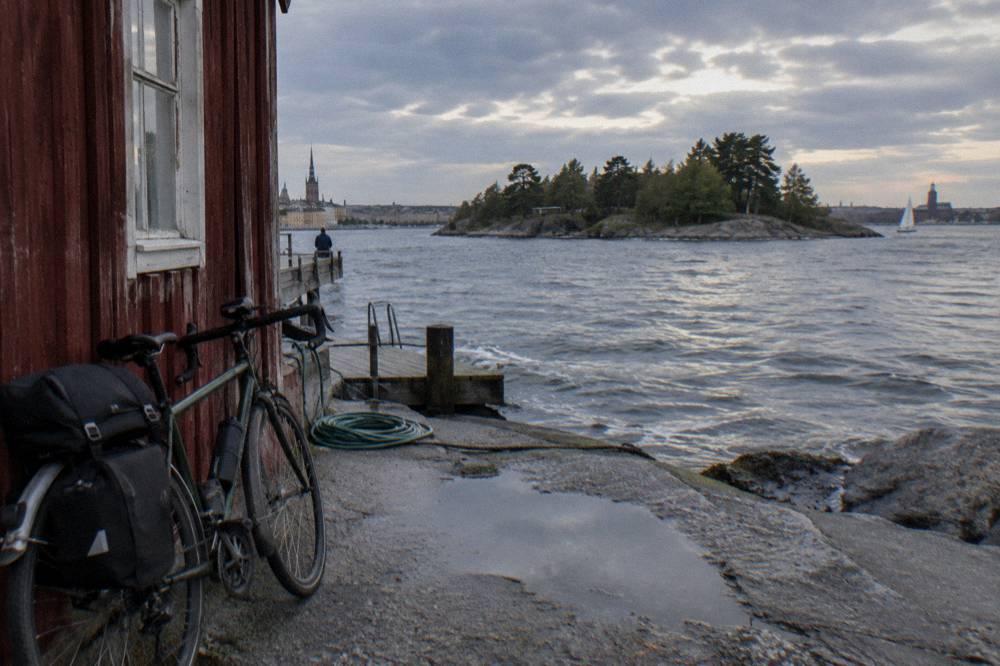
The light rule deserves a second mention because it surprises visitors at Nordic latitudes. In midsummer dusk barely arrives; in September it arrives quickly. Lights and reflectors are required when riding in darkness, front light white or yellow visible at 300 m and a red rear light visible at 300 m, and a 500 kr fine applies if you are caught unlit. Our what to wear guide works through the clothing layering in more depth.
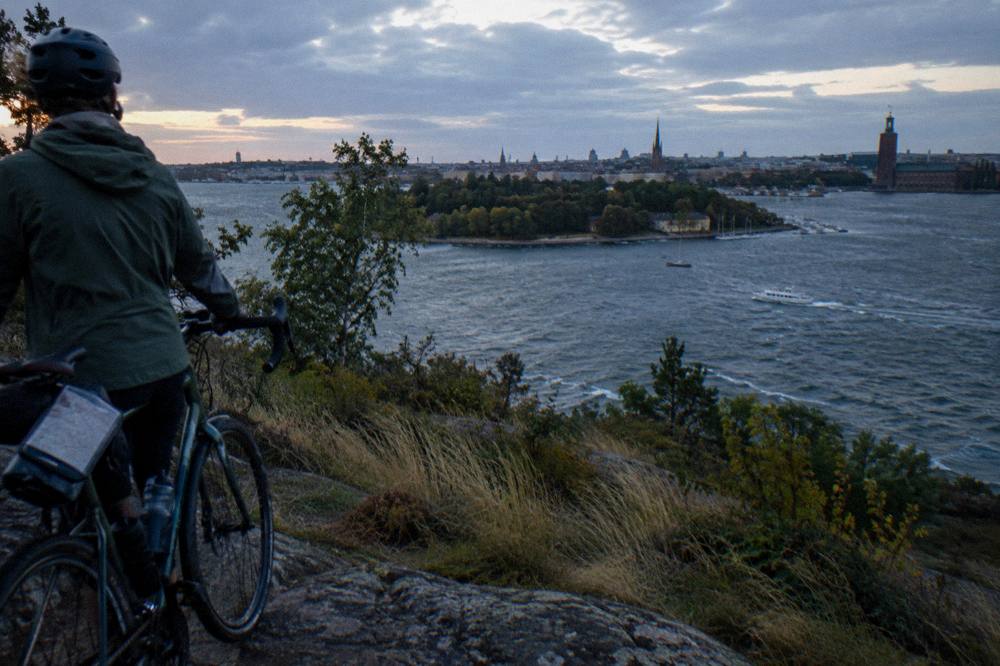
If pedalling into Baltic wind for five days does not sound like a holiday, an e-bike changes the arithmetic, and the city's e-bike products are the place to test whether assisted riding suits you at all. The Stockholm E-Bike City Tour is the dedicated electric option in the city, a 2 hour 30 minute shared ride; its price and meeting point are on the booking page. Swedish law treats pedal-assist bikes up to 25 km/h and 250 W as ordinary bicycles, so an e-bike archipelago rental carries the same ferry rules as any other bike, with the deck placement noted above.
Common Questions About Cycling The Stockholm Archipelago
Can You Cycle The Stockholm Archipelago?
Yes, as a ferry-and-bike trip: you ride each island and hop between them on scheduled boats. Packaged holidays cover roughly 220 km over five riding days, and independent day trips work on the inner islands using SL commuter boats and Waxholmsbolaget ferries.
Do Ferries Charge Extra For Bikes?
No, in the common cases. SL commuter boats, including the Djurgården ferry, carry a regular bike at no extra cost subject to space. Waxholmsbolaget allows one regular bike per person free if space allows; cargo bikes, tandems and other bulky bikes are charged 120 SEK as goods.
When Is The Best Season For Archipelago Cycling?
Mid-May to mid-September, which is exactly when the packaged operators run. July is the warmest month on the 1991 to 2020 normals with average highs near 23.6 C, June has the longest days at roughly 18.5 hours of daylight, and August is the wettest at around 66 mm.
Can You Take An E-Bike On The Archipelago Ferries?
Yes, with placement rules: e-bikes must stand on the open deck on both SL and Waxholmsbolaget boats, and on SL boats you may be asked to remove the battery and put it in the deck container. Charging lithium vehicles on board is banned across SL services.
Do You Need A Guide For Archipelago Cycling?
Not for the inner islands, which are small and well signed. Guides or packages add value on multi-island itineraries, where ferry connections and island logistics are the hard part. A guided city ride first, such as a 3-hour private tour priced per group, is a low-risk way to calibrate your pace.
Can You Rent A Bike For Archipelago Day Trips?
Yes, through the city's year-round rental shops and seasonal operators; one Djurgården rental opens for the season in late April with classic 3-speed city bikes. Check the rental's tyre type against island surfaces, since gravel lanes are common.