Stockholm City Bikes Or A Guided Ride?
Stockholm has no docked public bike scheme any more. What it has instead is shared e-bikes from two private operators and a set of guided rides that bundle a bike, a helmet and a local guide into one price. Here is how the two paths compare.
Short answer
The old docked Stockholm City Bikes scheme ended in 2018. Today the city's shared bicycles are e-bikes run by Voi and Bolt, announced as operators on 19 December 2025. A guided ride costs more per hour, but the bike, the helmet and the route come included, and current prices are on each booking page.
Stockholm's old docked bike scheme is gone, and the question it used to answer, how to get a bicycle for a few hours without buying one, now has two very different answers. One is a shared e-bike you unlock with an app. The other is a guided ride such as the Stockholm: Guided Bike Tour, where the bike, the helmet and the route arrive as a package. The choice shapes your whole day: how far you get, what you learn, and what you pay for.
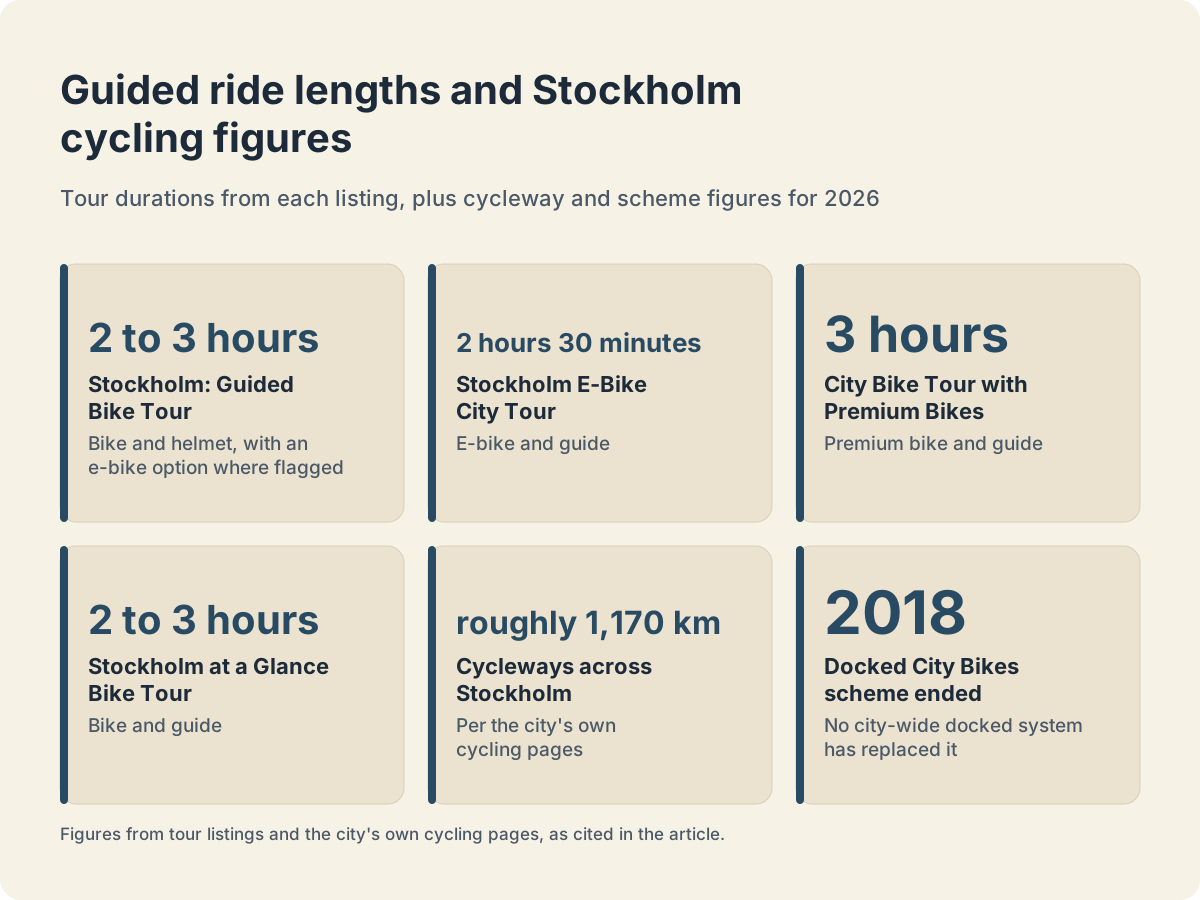
This comparison lays out what each option actually covers in 2026, from the shared-bike announcement of December 2025 to the cycle network you will be riding on, roughly 1,170 km of cycleways according to the city's own cycling pages. Where a price varies by group size, the live booking page shows the exact figure for your party. If you were hoping to skip paying altogether, the guide to free e-bike tours in Stockholm explains why no such tour is verified and how to ride the same cycleways at no cost instead.
What Happened To The Docked Stockholm City Bikes?
The docked Stockholm City Bikes scheme is reported to have ended in 2018 when its contract expired, and no city-wide docked system has replaced it. Anyone telling you to grab a bike from a City Bikes dock in 2026 is describing a service that stopped running years ago. The name still floats around old travel forums, which is exactly why it misleads.
Travel advice ages badly, and this is the clearest example on Stockholm's cycling scene. For years the docked scheme was the default answer to "how do I rent a bike here", and articles recommending it still surface near the top of search results. The scheme itself is gone. What exists instead is a dockless shared service, and even that changed hands recently: on 19 December 2025, Voi and Bolt were announced as the operators of Stockholm's shared bicycle service after a city evaluation process.
Voi and Bolt were announced as operators in December 2025; fleet sizes and rates are set in each app. Fleet sizes and per-minute prices are not confirmed figures this site will print. What is safe to say: two named operators, one city permit, and prices set in each operator's app rather than on a public tariff. If a blog quotes you a per-minute rate for a Stockholm shared bike, treat it as unverified until you see it in the app itself.
For a cyclist, the practical difference between a docked scheme and a dockless one is where your ride ends. A docked system wanted you back at a station. A dockless e-bike wants you parked somewhere legal, and in central Stockholm "somewhere legal" has real rules attached, which the sections below cover in detail.
How Do Shared E-Bikes Work Across The City?
Shared e-bikes in Stockholm work through the Voi and Bolt apps: find a bike on the map, unlock it, ride, and park it where local rules allow. There is no public tariff and no dock, so the price appears in the app before you confirm. The e-bikes are classed as bicycles, which means the full rulebook for cycling applies to them.
The system is simple at the surface. Download an app, add a payment card, and the map shows nearby bicycles. Rates, bundles and any subscription options live inside the app, and they change without notice, which is why this guide prints none of them. What does not change is the legal classification: an electrically assisted bicycle counts as an ordinary bicycle when the motor only assists pedalling, cuts out at 25 km/h and has at most 250 W of continuous rated power, per the Swedish transport agency's rules. That matters because it puts shared e-bikes on the cycle lanes, under the helmet rules for riders under 15, and subject to the same fines as any bike.
Where the convenience frays is parking and geography. Gamla Stan's inner streets are pedestrian streets, where cycles move at walking pace and yield to pedestrians, and e-scooters are banned there except along Munkbroleden and Skeppsbron. On Djurgården, by contrast, no specific shared-vehicle bans are listed and bicycles are the recommended way to explore. So a shared e-bike is at its best on the big island and the Södermalm waterfront, and at its worst precisely in the medieval core most visitors want to see first.
The shared option also has a ceiling a first-time visitor may not expect. Nothing narrates the city. You get from A to B cheaply and quickly, but the story of why Gamla Stan's streets twist the way they do stays untold unless you carry a guidebook and stop constantly. That is the gap a guided ride fills, and it is why the two options serve different days rather than competing head-on.
| Question a rider asks | Shared e-bike (Voi or Bolt) | Guided ride |
|---|---|---|
| Where do I get the bike? | On the street, via the app map | A fixed meeting point from the listing |
| What does it cost? | App tariff, shown before you unlock | Per-person price on the booking page |
| Who picks the route? | You do | The guide does |
| Where does it end? | Wherever you park it legally | Back at or near the meeting point |
| Is a helmet included? | No | On tours that flag it in the listing |
What Does A Guided Ride Include That A Shared Bike Does Not?
A guided ride includes the bicycle, a helmet and a guide who routes the day, all in one price and one meeting point. A shared bike includes none of that: you supply the navigation, the route knowledge and the safety gear choice. The Stockholm: Guided Bike Tour runs 2 to 3 hours with bike and helmet flagged in its listing, and its current price sits on the booking page.
The inclusion list is where the comparison stops being close. On a shared e-bike, everything beyond the bike itself is your problem: where to ride, what to skip, how the ferry to Djurgården works, and what the rules are on a pedestrian street. A guided ride moves that entire planning layer onto the operator. The Stockholm: Guided Bike Tour lists a bike and helmet among its inclusions and runs 2 to 3 hours, long enough to bridge the city centre, and its listing shows an e-bike option where that flag applies, so check the booking page if you want the assist.
The format choices stack up from there. The Stockholm E-Bike City Tour covers the same city-centre ground on electric assist over 2 hours 30 minutes, which flattens Stockholm's few but real climbs. The Stockholm: City Bike Tour with Premium Bikes goes 3 hours on higher-spec machines for riders who care about the bike itself. Each card shows a from-price; the live booking page confirms the exact amount for your dates.
| Tour | Length | Bike and format | Included per the listing |
|---|---|---|---|
| Stockholm: Guided Bike Tour | 2 to 3 hours | Classic, shared group | Bike and helmet, with an e-bike option where flagged |
| Stockholm E-Bike City Tour | 2 hours 30 minutes | E-bike, shared group | E-bike and guide |
| Stockholm: City Bike Tour with Premium Bikes | 3 hours | Premium classic bikes | Premium bike and guide |
| Stockholm at a Glance Bike Tour | 2 to 3 hours | Classic, shared group | Bike and guide |

What a guide adds that no app replicates is judgment on the day. Operators report adjusting routes around roadworks, which matter in a city currently rebuilding cycle infrastructure at pace, from the widened Riddarholmskanalen path that reopened on 17 April 2026, two months early, to the new northbound lane on Vasabron finished in June 2026. A shared bike hands you a map of that churn. A guided ride simply rides the version that works this week.
Between the two, group size and pace decide more than price does. Shared e-bikes suit the independent traveler who already knows the city's shape. A guided small-group ride suits the first timer, the family, and anyone who would rather ask a person than scroll a map. That decision logic, not the hourly maths, is what the rest of this guide unpacks.
Can A Shared Bike Cover Djurgården And The Ferry?
Yes, and well. Djurgården is one of the most bicycle-friendly parts of Stockholm, with no shared-vehicle bans listed for the royal park, and the Djurgården ferry carries bikes at no extra charge subject to space, since it is a regular SL pendelbåt service. Staff judge the space and can point you to a later departure when the deck is full.

The ferry detail is the one that catches people out, in a good way. The Djurgården ferry between Slussen and the island is an ordinary SL commuter boat, and SL's own rules state plainly that taking a bike on the pendelbåtarna costs nothing extra, always subject to available space. E-bikes go outdoors on the deck, and if deck space runs out you remove the battery and place it in the on-board container. No fare is printed here, because the passenger ticket is an SL matter and prices belong to SL's own pages, not to a cycling guide guessing at them.
One seasonal wrinkle shapes any Djurgården plan. From 30 April to 27 September 2026, the Djurgårdsbommen and Vasabommen barriers closed the island's interior to most vehicles on a seasonal schedule, with exceptions for buses, taxis and permit holders. Cyclists were not among the excluded. The effect is that in the warm half of the year the island's interior belongs overwhelmingly to bikes and feet, which is exactly why guided rides route through it and why the Royal Djurgården authority's own page is worth a glance before you set out.
The comparison point is narration again. A shared e-bike gets you to the Vasa Museum's doorstep, but the museum's new Vasa Walk audio guide, launched on 29 October 2026 and running from outside the museum across Djurgården to Beckholmen, is the kind of addition a guide weaves into a ride unprompted. Guided tours of the island, like the Djurgården by bike plan on this site, exist because the island repays context.
Bikes and transit interact elsewhere in ways a shared-bike rider should know before trusting a metro exit. Full-size bikes are never allowed on SL buses, the metro or the inner-city trams, per SL's carry-on rules. They are allowed on commuter trains, the Tvärbanan light rail outside rush hours, and the commuter boats, with conditions. The official SL bicycle page lists every line and every condition, and it is the only source worth trusting on this, because the rules changed as recently as November 2024.
| SL service | Full-size bike policy |
|---|---|
| Buses and the metro (Tunnelbana) | Never allowed |
| Spårväg City and Nockebybanan trams | Never allowed |
| Commuter trains (pendeltåg) | Allowed outside weekday rush hours, with station restrictions |
| Tvärbanan light rail | Non-electric bikes allowed outside rush hours, secured in on-board stands; e-bikes never |
| Commuter boats, including the Djurgården ferry | Allowed at no extra charge, subject to space; e-bikes on deck |
What Does Each Option Cost For A Full Day?
Shared e-bike rates are set in the Voi and Bolt apps and vary; check the app before you unlock. Guided rides carry per-person prices on their booking pages, and the honest comparison is not per hour but per outcome: a shared bike sells transport, a guided ride sells transport plus route plus guide. If you want actual figures instead of app menus, the guide to what one day of bike rental in Stockholm costs covers tour prices, shared e-bikes, deposit habits, and what the law requires your bike to carry.
Shared-bike pricing is set in the apps and changes often. Stockholm's shared-bike pricing is app-based, promotional and changeable, and everything a third party quotes tends to be stale within a season. Guided-ride pricing is at least published, per person, on each operator's booking page at the moment you book. What can be compared structurally is what the money buys:
| What the day needs | Shared e-bike (Voi or Bolt) | Guided ride |
|---|---|---|
| The bicycle itself | Included, app-priced | Included in the tour price |
| Helmet | Not provided; riders under 15 must wear one by law | Included on tours that flag it in the listing |
| Route and navigation | Your own planning | Chosen and adjusted by the guide |
| Local context | None | The core of the product |
| Where it can go | Anywhere cycling is legal; walking pace in Gamla Stan | City centre and islands per the tour's route |
| Ends when | You park it | Tour ends at a set point, typically near the start |
Two cost behaviours are worth naming. Shared e-bikes bill by use, so a full day of stop-start sightseeing, unlocking and re-locking at every museum, can quietly outpace a single guided-ride ticket that covers 2 to 3 focused hours. Conversely, a rider who wants one 40-minute hop across Södermalm will never beat the shared bike on price, and no guided tour should be sold to that person.
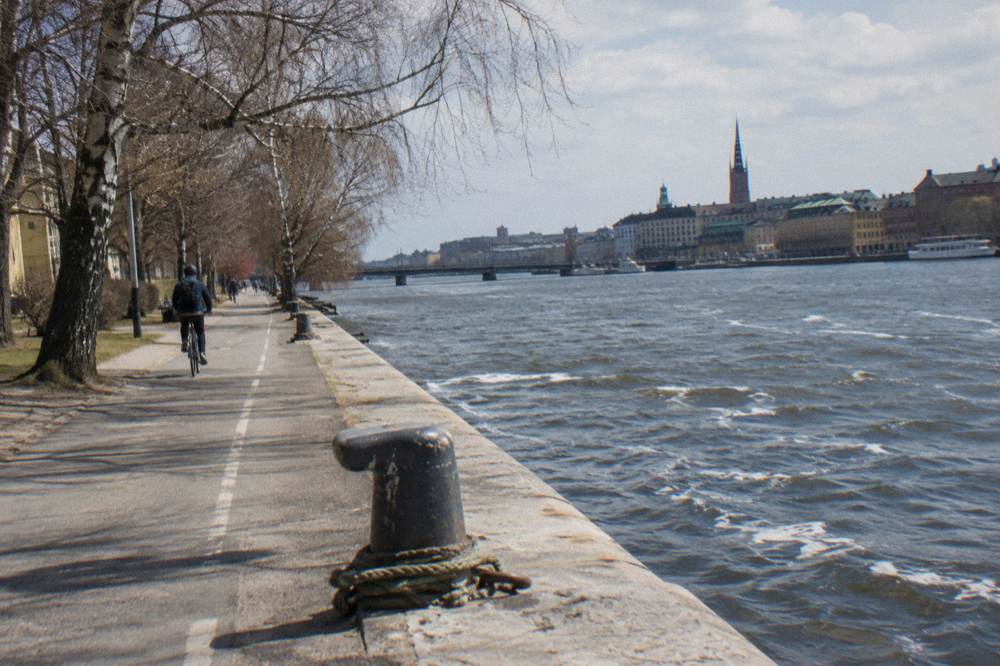
There is also a middle path that muddies the neat binary. Independent rental shops, including year-round ones in the old town and seasonal operations on Djurgården such as the rental that opened for the 2026 season on 30 April with classic 3-speed city bikes, sell plain bikes by the day. That suits a self-guided full-day loop, the one day by bike and ferry itinerary on this site, better than either per-minute sharing or a 3-hour guided window. Rental rates are shop-specific and not printed here.
When Is The Weather Working For You?
The SMHI 1991 to 2020 normals put July as Stockholm's warmest month at an average high of 23.6 C, with June the brightest at 18.5 hours of daylight per day. Guided rides run to their own seasonal calendars, checked on the booking page. Shared e-bikes sit outside, so rain affects both options roughly equally.
The numbers tell a clear seasonal story. The May to September window carries average highs from 16.5 C to 23.6 C and daylight from 17.0 down to 12.8 hours per day, while November averages a 5.4 C high with 7.7 hours of daylight. February through April are the driest months on the normals table, at 29.4 mm, 27.3 mm and 29.2 mm respectively, and August is the wettest at 66.2 mm. None of this is a forecast; they are 30-year averages, and any given week will depart from them.
| Month | Avg high C | Avg low C | Precip mm | Daylight hours per day |
|---|---|---|---|---|
| May | 16.5 | 7.1 | 34.0 | 17.0 |
| June | 20.8 | 11.6 | 61.7 | 18.5 |
| July | 23.6 | 14.8 | 61.5 | 17.7 |
| August | 22.1 | 14.2 | 66.2 | 15.5 |
| September | 16.6 | 10.2 | 53.3 | 12.8 |
| November | 5.4 | 1.9 | 47.6 | 7.7 |

Winter does not end cycling in Stockholm, but it changes the calculus. The city sweeps and salts roughly 38 mil of cycle lanes, per its traffic information service, specifically so commuting and leisure cycling continue through the dark months, and cycling is openly recommended year-round with the right gear and tyres. The first snow in Stockholm falls, on average, around 26 November according to SMHI statistics. A guided winter ride with proper equipment is a real product category here, not a novelty, and the best time of year to cycle guide covers the month-by-month trade-offs.
The comparison twist is that weather punishes the two options differently. A shared e-bike in November drizzle means standing on a street corner unlocking a wet machine with cold fingers. A guided ride at least starts and ends at a fixed meeting point with a human being who has already decided whether the route changes. The rain-day guide on this site covers what operators actually do when the forecast turns.
So Which Should You Choose For Stockholm?
Choose a shared e-bike if your day is short-hop and self-directed: one crossing, one island, one errand. Choose a guided ride if this is your first Stockholm day, if you are with family, or if you want the city explained rather than traversed. The strongest pattern is both: a guided ride on day one, shared e-bikes for the loose ends after.
That hybrid is not a hedge, it is how the products actually fit together. A guided ride front-loads orientation: after 2 to 3 hours with a guide you know the pedestrian-street rules, the ferry quirk and the shape of the islands, and everything after that is cheaper on a shared bike. The Stockholm at a Glance Bike Tour exists precisely for that first-morning role, a 2 to 3 hour orientation sweep, while the Wooden Bicycle Tour, 2 hours on distinctive wooden-framed bikes, leans toward the memorable-vehicle end of the same decision.
Families should weight the choice toward guided. The helmet law applies to every rider under 15, and a tour that supplies helmets and paces itself to children removes the two biggest failure modes of a family shared-bike day: gear gaps and stamina mismatches. The family and kids guide on this site covers the specifics, including which listings flag child seats and child bikes.
Rules knowledge is the last differentiator, and Stockholm has real fines attached. Riding a pedestrian street faster than walking pace is a 1,000 kr penalty, running a red light on a bike is 1,500 kr, and missing lights in darkness, or a missing bell at any time, is 500 kr each, per the national rules summarised by police. A shared-bike rider learns these by reading; a guided group learns them by being routed correctly all day. The cycling rules guide carries the full list in one place.
| If your day looks like this | Pick this | Why |
|---|---|---|
| First visit, want the city explained | Guided ride, 2 to 3 hours | Route, guide and helmet in one price |
| One or two short hops across town | Shared e-bike | Cheapest for brief point-to-point use |
| Family with children | Guided ride | Helmets and child pacing included on family listings |
| Full-day self-guided loop | Shop rental by the day | A flat day rate beats per-minute billing |
| Returning visitor filling gaps | Shared e-bike after one guided day | Orientation already done, freedom after |
The shared-versus-guided question ultimately resolves into what kind of day you want. Transport, or an experience. A city you move through, or a city that gets explained while you ride it. The Stockholm Bike Tours comparison set on this site exists because most visitors land somewhere between the two, and the honest recommendation is the hybrid: guided first, shared after.
Common Questions About City Bikes Versus Guided Rides
Does Stockholm Still Have Public City Bikes?
No. The docked Stockholm City Bikes scheme is reported to have ended in 2018, and no city-wide docked system operates today. Shared e-bikes from Voi and Bolt, announced as the city's operators on 19 December 2025, are the current shared option, priced in their apps.
Is A Guided Bike Tour Worth It If I Can Just Rent A Shared E-Bike?
It depends on what you want. A shared e-bike sells transport only. A guided ride such as the Stockholm: Guided Bike Tour, 2 to 3 hours with bike and helmet included, sells the route, the pacing and the local knowledge, which matters most on a first visit or with children.
Can I Take A Shared E-Bike On The Djurgården Ferry?
Bikes ride the Djurgården ferry, an SL commuter boat, at no extra charge subject to space, and e-bikes are placed on deck. Staff judge space and safety on the spot and can direct you to a later departure. No passenger fare is printed here; check SL's own pages.
Where Am I Not Allowed To Ride In Central Stockholm?
Gamla Stan's inner streets are pedestrian streets: walking pace, yielding to pedestrians, with e-scooters banned except along Munkbroleden and Skeppsbron. Full-size bikes are also never allowed on SL buses, the metro or the inner-city trams, whatever kind of bike you are riding.
Which Is Cheaper For A Whole Day Of Sightseeing?
There is no honest single figure. Shared e-bike pricing lives in the Voi and Bolt apps and is not published as a fixed tariff, and guided-ride prices sit on each booking page. Stop-start sightseeing on a shared bike can add up, while a single guided ticket covers one focused block of hours.
Do I Need A Helmet?
By law, every rider under 15 must wear a helmet; adults have no legal requirement. Fines attach to an adult carrying a helmetless child. Guided rides that list a helmet among their inclusions remove the question entirely, which is one quiet argument for them on family days.