What To Wear On A Stockholm Bike Tour
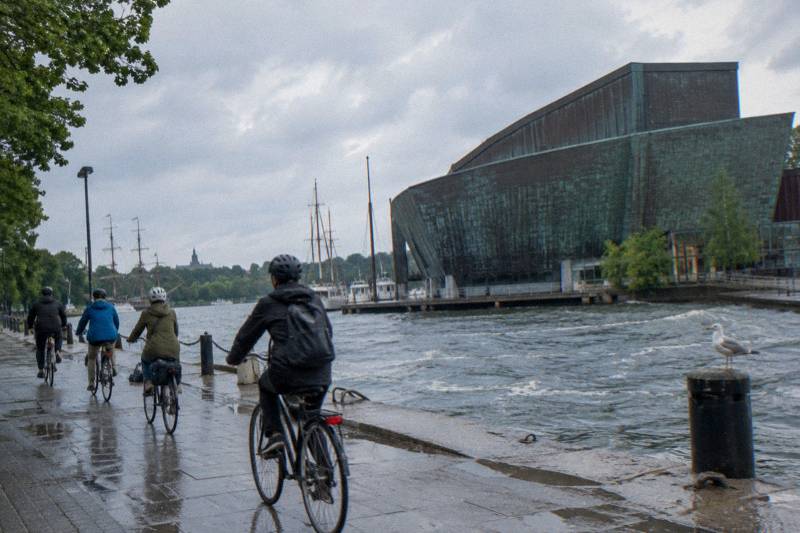
Stockholm's weather changes fast, and a half-day ride crosses open waterfronts, forest paths and cobbled old town streets. Here is what to wear, season by season, with the small kit list that makes the difference between a good ride and a cold one.
Short answer
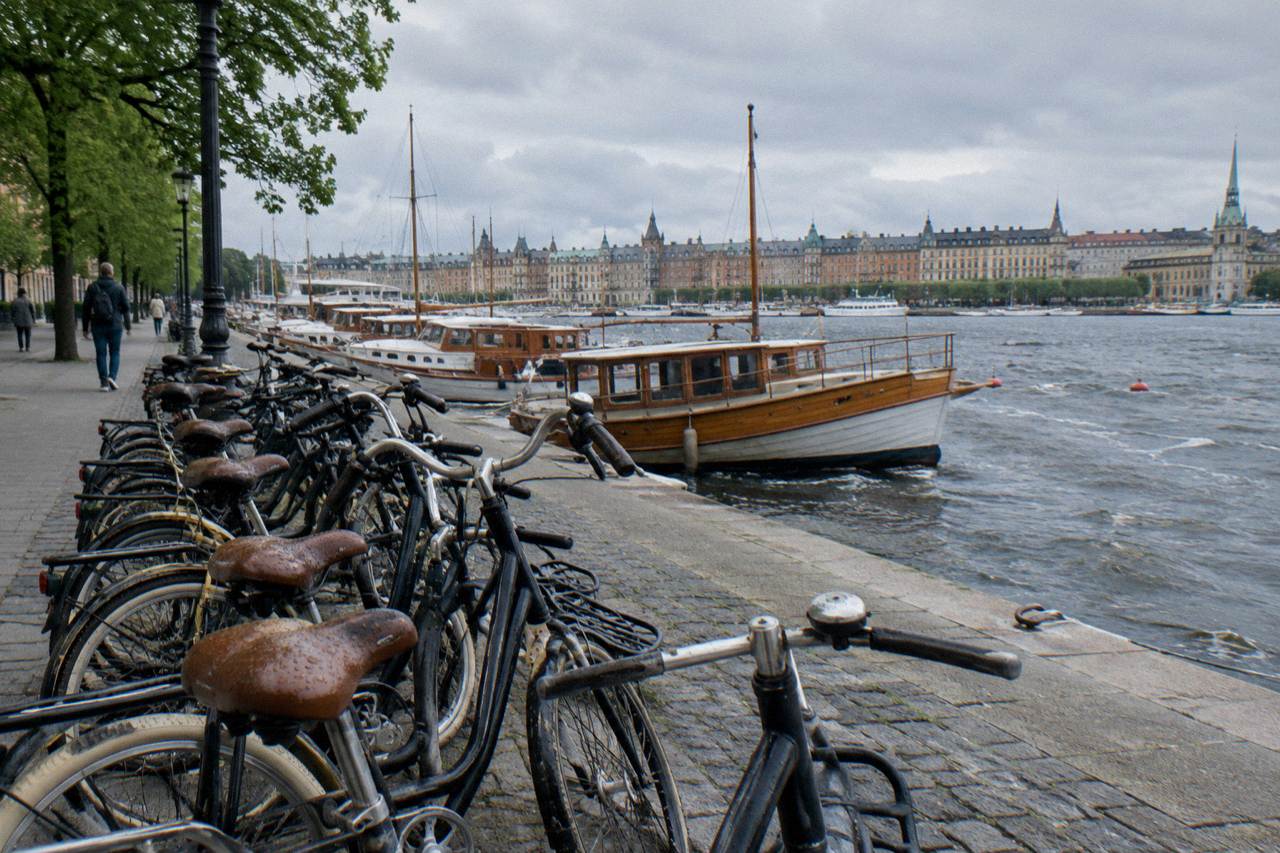
Dress in layers you can shed, wear closed shoes with grip, and bring a rain shell whatever the season. A helmet comes with the tour, lights are only a legal requirement in darkness, and rain gear matters most from June to August, when Stockholm averages 61 to 66 mm of rain per month.
What Should You Wear On A Stockholm Bike Tour?
Wear layered clothing you can remove in stages, closed shoes with a firm grip, and a light rain shell in your bag in every season. The ride is 2 to 3 hours at a conversational pace, you generate heat quickly, and Stockholm's average temperature swings from about -2.9 C at night in January to a 23.6 C afternoon high in July, so no single outfit covers the year.
The mistake most first-time visitors make is dressing for the temperature outside their hotel door. Cycling changes the equation twice over: your core warms up within ten minutes, but your hands, ears and feet sit still in the wind, especially crossing the open bridges between Gamla Stan, Södermalm and Djurgården. Wind off the water is a real factor on Slussbron and the Djurgården bridges even in midsummer. Plan for a body that runs warmer than walking pace and extremities that run colder. Once you're dressed for those bridge crossings, our district-by-district guide to cycling in Stockholm helps you decide where to point the bike first.
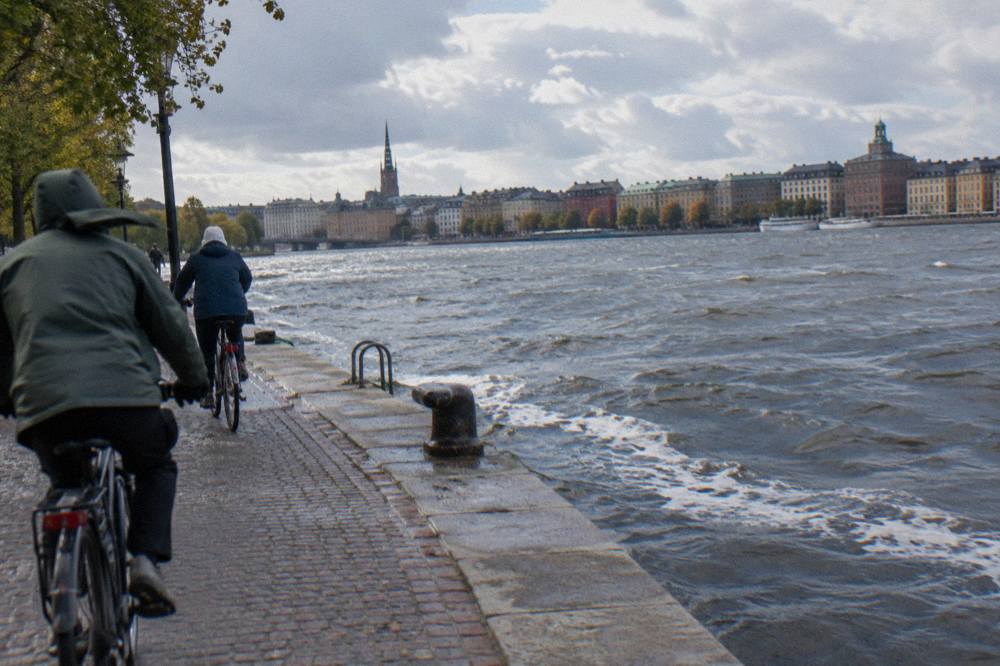
The second factor is what the ride itself looks like. A typical half-day city tour mixes separated cycle lanes, quiet streets and a stretch of cobbled or gravel surface in the old town or on Djurgården. None of it is technical, but it rewards shoes that stay put on pedals and trousers that do not flap into a chain. Think of it as dressed-up hiking, not sport cycling: nothing you would be afraid to walk into a museum in afterwards.
The featured city ride, Stockholm: Guided Bike Tour, runs 2 to 3 hours and the listing includes a bike and a helmet. Beyond that, what the operator supplies varies by listing, so treat clothing as your own responsibility and check the booking page for anything specific, such as child seats or the e-bike option. If you are still weighing whether a guided ride suits you at all, the comparison of a rental bike versus a guided ride covers the trade-offs.
Which Layers Work For Stockholm's Seasons?
Build around a base layer, a warm mid layer and a windproof outer, and adjust the thickness by month. From May to September a t-shirt plus a light jacket covers most days; from October to April you want a fleece, a proper wind shell, gloves and a warm hat under the helmet, because average lows sit between -3.2 and 5.5 C from October to April.
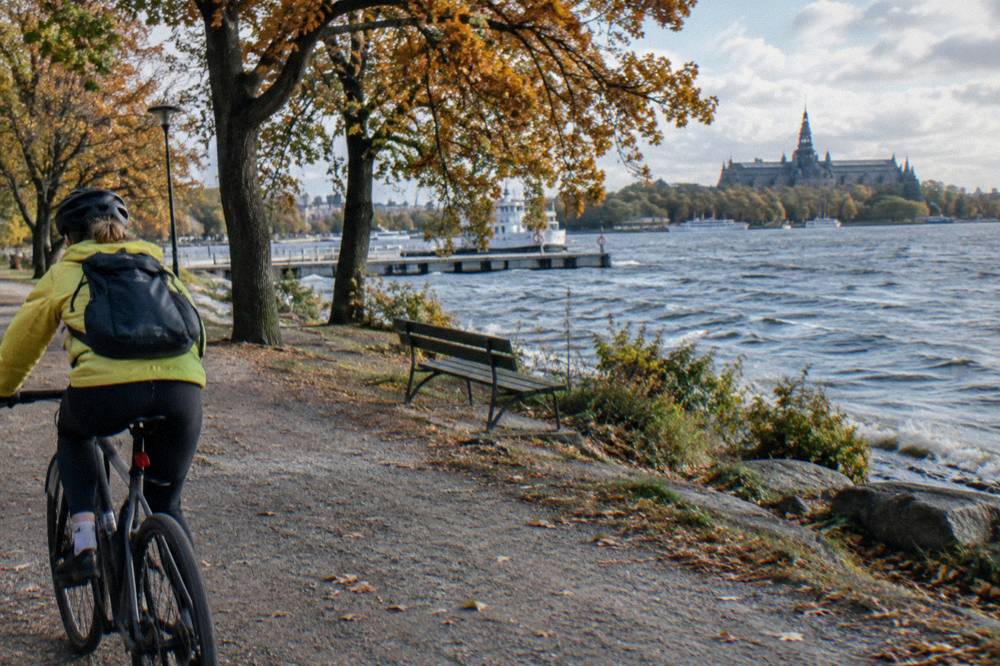
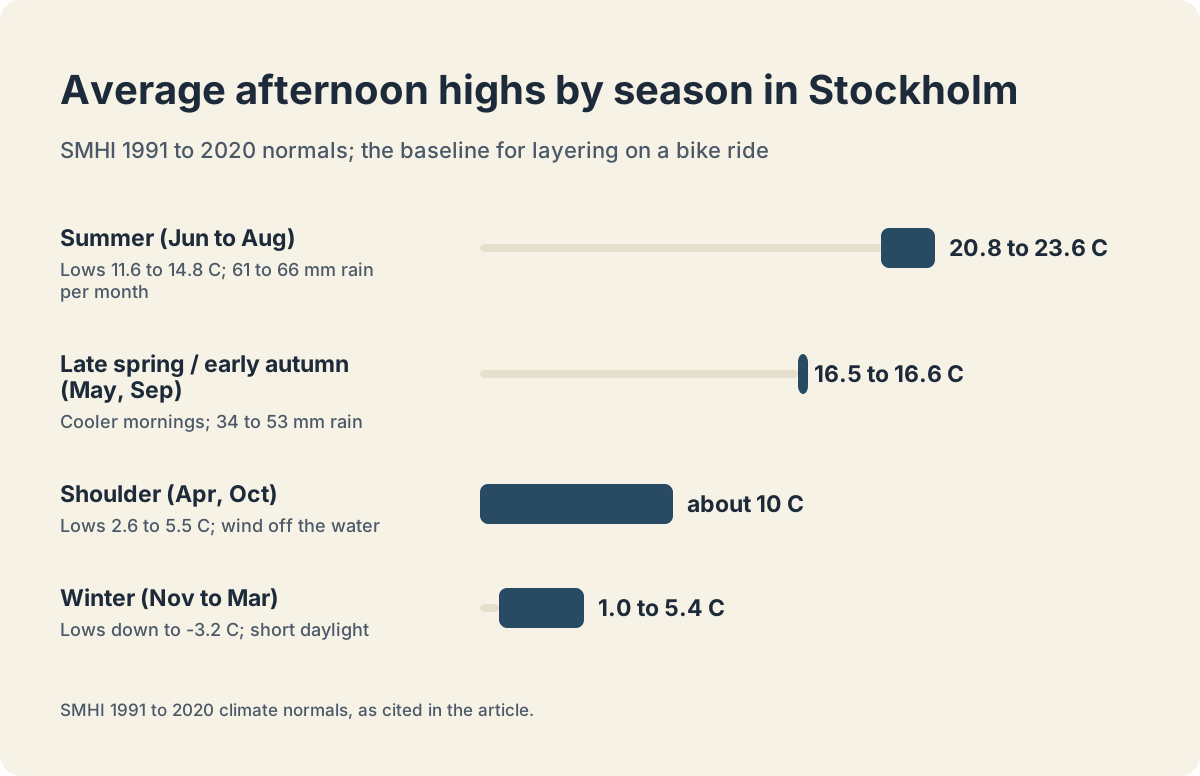
Stockholm's seasons are genuinely distinct, and the difference between a June afternoon and a February morning is about 20 C in the average high. The SMHI 1991 to 2020 normals put June, July and August at average highs of 20.8, 23.6 and 22.1 C, which is short-sleeve weather with a jacket in the bag. April and October are the swing months: average highs of 10.7 and 10.1 C feel pleasant in sun and raw in wind, and both carry around 29.2 mm and 51.4 mm of rain respectively. The colder months are perfectly rideable, and the city sweeps and salts about 38 mil of cycle lanes to keep them usable, but they demand real insulation.
| Season | Months | Typical conditions (SMHI normals) | What to wear |
|---|---|---|---|
| Summer | Jun to Aug | Highs 20.8 to 23.6 C, lows 11.6 to 14.8 C, 61 to 66 mm rain per month | T-shirt or light shirt, arm warmers optional, light wind jacket in the bag, sunglasses |
| Late spring / early autumn | May, Sep | Highs 16.5 to 16.6 C, cooler mornings, 34 to 53 mm rain | Long-sleeve base, light fleece or mid layer, windproof shell |
| Shoulder | Apr, Oct | Highs about 10 C, lows 2.6 to 5.5 C, wind off the water | Base layer, fleece, wind jacket, light gloves, long trousers |
| Winter | Nov to Mar | Highs 1.0 to 5.4 C, lows down to -3.2 C, short daylight | Thermal base, warm mid layer, windproof outer, insulated gloves, warm socks, hat or balaclava under helmet |
Two practical notes on the table. First, the rain column is a monthly average, not a daily forecast: an August cloudburst can drop a third of the month's total in an afternoon, which is why the rain shell travels with you even on a bright morning. Second, daylight shrinks fast in autumn. By November the city is down to 7.7 hours of daylight per day, and if your ride starts or ends in dim conditions, lights matter, which leads into the rules section below. For a fuller month-by-month picture of when to ride, see the best time of year to cycle in Stockholm.
What Shoes Should You Wear For Cycling In Stockholm?
Wear closed, comfortable shoes with a flat sole and some grip: trainers, light hiking shoes or casual sneakers all work. Avoid smooth leather soles, flip-flops and brand-new stiff boots, because a half-day ride mixes pedals, cobblestones in Gamla Stan and walking stops, and your feet do all three.
There is no footwear rule for cyclists in Sweden, so this is purely comfort and safety. What the city does have is surface variety. Gamla stan's pedestrian streets are cobbled, Djurgården's park paths are partly gravel, and rain makes both slicker than they look. On the pedestrian streets cyclists must ride at walking pace and give way to pedestrians, which means you will put a foot down and walk short sections. A shoe that grips wet cobblestone does more for your safety than any technical cycling feature.
Sandals are a summer temptation, and on a dry July day they are survivable. The case against them is the same as everywhere: exposed toes, pedal pins and the odd stone flicked up on gravel. If you run cold, note that feet are the first thing to numb on a windy bridge crossing, so in the October to April window a slightly warmer shoe plus wool socks beats a bigger jacket.
One packing tip specific to guided tours: most city rides include at least one stop where you walk into a café, a courtyard or a museum forecourt, and you may keep the same shoes for the rest of your day. Shoes that work on a bike and in a restaurant are worth more on this trip than cycling-specific ones.
Do You Need Rain Gear On A Stockholm Bike Tour?
Yes, in every season, at minimum a light packable rain shell. Summer is actually the wettest time of year by monthly average, with 61.7 mm in June, 61.5 mm in July and 66.2 mm in August, and showers can arrive quickly. From October onwards a proper waterproof jacket, and ideally rain trousers, become standard kit rather than a just-in-case item.
Swedish rain in summer is usually a shower, not a day-long drizzle: it hits hard and passes. A packable shell that fits over your layers handles 90 percent of summer situations and costs you a fist-sized corner of a daypack. In the colder months the same shell does double duty as your windproof layer, so it earns its place twice. Rain trousers are the item people skip and then regret, because wet thighs on a windy bridge are miserable in a way a wet jacket never is.
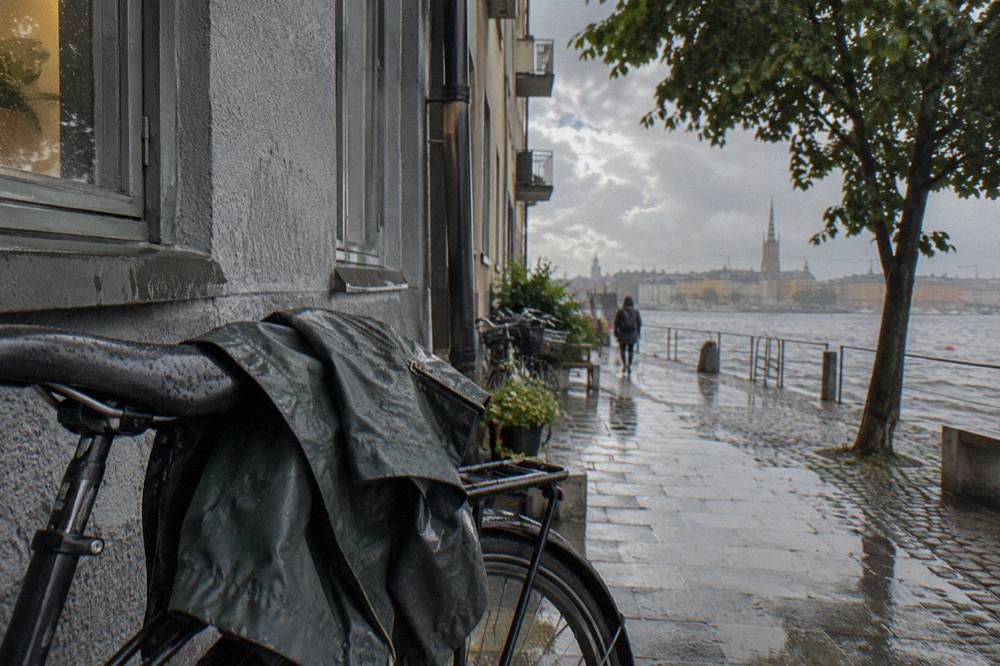
Check what the tour itself provides before buying anything. Some listings flag a poncho among the inclusions, and where they do, that covers the jacket half of the problem. Never assume beyond what the booking page states, and if rain is forecast for your ride day, the deeper playbook, including how tours handle genuinely wet departures, is in what to do when your Stockholm ride lands in rain.
Beyond rain, think about what stays dry. A dry bag or a simple zip-lock for your phone and any layers you shed is the cheapest upgrade to a day on a bike. Gloves that stay grippy when damp are worth more than dry ones that do not.
Is A Helmet Provided On Bike Tours In Stockholm?
On the standard guided listings, yes: a helmet is flagged among the inclusions, and the featured city tour is no exception. Adults are not legally required to wear one in Sweden, but every child under 15 must, and an adult carrying a child without a helmet can be fined 500 kr by the police. Wearing the provided helmet is normal practice on guided rides.
The law is age-specific. The Swedish transport agency states that everyone under 15 must wear a helmet when cycling or riding as a passenger, and there is no helmet requirement for adults. Most guided listings include a helmet; confirm on the booking page before you ride. Taking it costs nothing and, on a route shared with trams and pedestrians, it is an easy call.
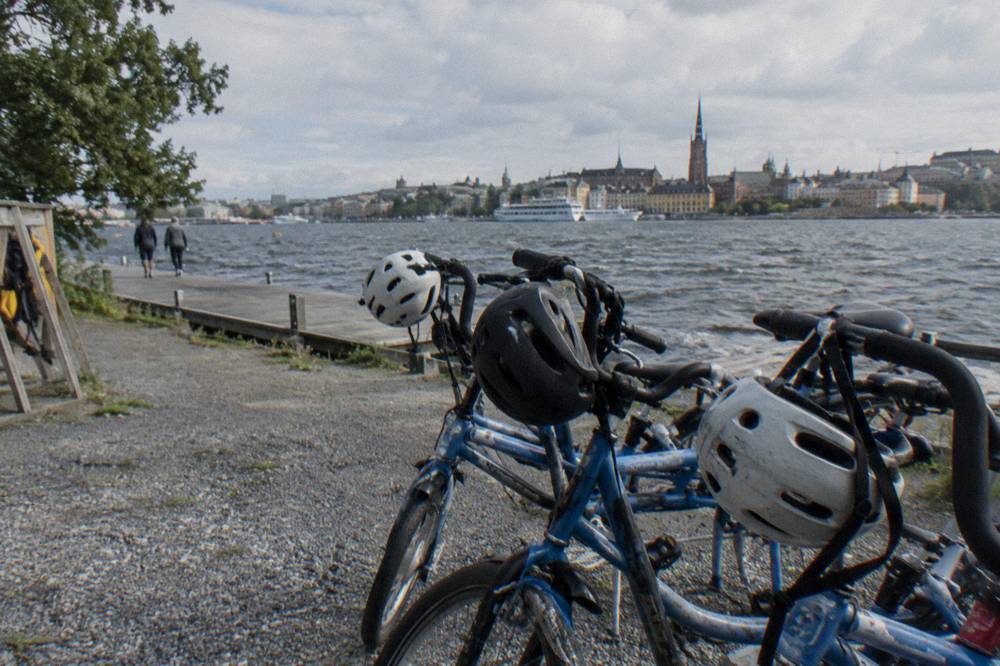
Your clothing connects to the helmet in two ways. A warm hat or thin beanie under a helmet is what makes winter rides comfortable, so pack one from November to March. And long hair travels better tied back, because helmet straps plus loose hair plus wind is a combination nobody enjoys for three hours. If you want the legal picture in full, including fines for lights and pedestrian-street riding, see the cycling rules that apply across Stockholm.
The child question matters for families booking a ride. Children under 15 riding on the tour must have helmets, which the operator supplies on family-flagged listings; the booking page is the place to confirm child bikes, seats and trailer options for your specific date. For a wider look at riding with kids, the family and kids bike tour guide lays out the options.
What About Lights, Reflectors And The Clothing Rules?
Lights and reflectors on the bike are required only when riding in darkness; there is no clothing-specific law for cyclists. Since the rules attach to the bicycle rather than the rider, and guided tours supply the bike, your only real decision is visibility: bright or reflective outer layers are sensible from October to March, when Stockholm is down to 6.2 to 11.9 hours of daylight per day.
The police guidance is specific about the equipment: in darkness the bike must carry a rear red light and a front light visible at 300 m, plus reflectors, and riding without them draws a 500 kr fine. Lights are required in darkness only, and a bike must always have a bell and working brakes. On a guided tour the operator's bikes carry this equipment, so a midday summer ride needs nothing from you. If you want to avoid other common slip-ups, from sidewalk cycling to less obvious rule-breaking, read up on the tourist mistakes that can earn you a fine in Sweden.
Your clothing is your own choice, but choice and sense diverge in winter. A dark jacket at 15:30 in November, with the sun down before 16:00, is a gamble on every driver's attention. Something bright, or a reflective strip on a sleeve or bag, is the cheapest safety upgrade of the whole kit list, and the police pages on cycling rules and fines and the transport agency's bicycle equipment rules set out the full requirements.
| Item | Legal status | Practical note for a tour |
|---|---|---|
| Helmet | Required under 15; optional for adults | Supplied on guided listings; bring a thin hat for winter |
| Bike lights | Required in darkness only; 500 kr fine if missing | Operator's bikes carry them; only your concern on early or late winter rides |
| Bell and brakes | Required at all times; 500 kr fine | Part of the supplied bike |
| Reflective clothing | Not legally required | Strongly sensible October to March, when daylight runs 6.2 to 11.9 hours per day |
| Riding on pedestrian streets | Walking pace, yield to pedestrians; 1,000 kr fine if faster | Applies in Gamla stan; guides route accordingly |
What Should You Wear On A Winter Ride Or An Archipelago Day?
For a winter ride, go full thermal: a moisture-wicking base layer, an insulating mid layer, a windproof shell, insulated gloves, warm socks and something under the helmet, because average highs sit between 1.0 and 5.4 C from November to March. For an archipelago day, add wind protection for ferry crossings and check whether your chosen ride is actually a boat-and-bike itinerary rather than a city loop.
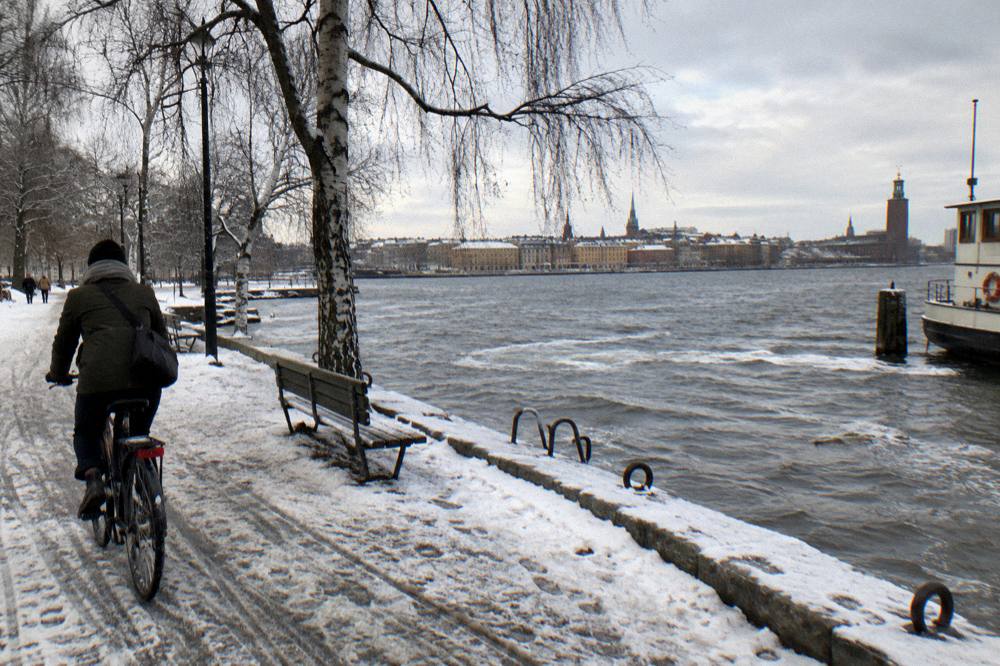
Winter riding in Stockholm is a real, supported activity rather than a hardship. The city's traffic operator encourages year-round cycling and salts the priority cycle network to keep it in bare-weather condition down to about -6 C, per its winter maintenance notice. The limiting factor for a visitor is less the cold than the darkness: December averages 6.2 hours of daylight per day, so morning and afternoon rides both brush against the lighting rules covered earlier.
The layering principle is the same one from the seasons table, executed more seriously. Avoid cotton next to the skin, because sweat chills you the moment you stop. Protect the contact points: hands on bars, feet on pedals and ears under the helmet vents are where heat escapes fastest. A balaclava or thin beanie designed to sit under a helmet solves the ears problem for almost no bulk.
Archipelago itineraries change the clothing brief in one direction: wind and water. Ferry decks are exposed and colder than the shore, and a boat-and-bike day can swing between sweating on a climb and shivering on a crossing within the hour, so a packable wind layer you can reach without unpacking everything is the item that earns its place. Some e-bike tours run through winter with winter tires and gear supplied, per the operator listings, which is worth checking on the booking page if a cold-weather electric ride appeals. The wider route picture is in cycling the Stockholm archipelago.
One variant worth naming for its clothing implications: the forest ride with sauna and homemade lunch, a 5-hour shared tour. A five-hour day through forest trails, at any time of year, wants more serious shoes and more layers than a 2-hour city loop, and the sauna at the end rewards a swimsuit and a change of clothes in your bag. Check the listing for what is included before you pack for it.
What Should You Pack Beyond Clothing?
Pack light and pack flat: a phone in a weatherproof pocket or bag, a water bottle, sunscreen from April to August, sunglasses in summer, a small dry bag, and your booking confirmation. Leave the bulky items at the hotel, because bikes on guided tours carry panniers rarely and handlebar bags almost never, and you will want hands free for photos.
Sun protection surprises people at this latitude. Stockholm gets long, angled summer sun, with 18.5 hours of daylight per day in June, and a three-hour ride facing the water exposes face and neck continuously. The same low angle makes sunglasses genuinely useful on evening rides, not just midday ones. From late May to early August, sunscreen belongs in the kit even when the sky is overcast, because a thin cloud layer cuts warmth more than it cuts UV.
| Item | When it matters | Why |
|---|---|---|
| Rain shell | Every season | Summer is the wettest quarter; 61 to 66 mm per month Jun to Aug |
| Light gloves | Apr to Oct, always Nov to Mar | Hands sit still in wind on bridge crossings |
| Warm hat under helmet | Nov to Mar | Helmet vents dump heat fast at 1 to 5 C |
| Sunglasses and sunscreen | May to Aug | Up to 18.5 hours of daylight, low angled sun over water |
| Dry bag or zip-lock | Every season | Keeps phone and shed layers dry through showers |
| Water bottle | Every season | 2 to 3 hours of riding at a steady pace |
| Change of clothes | Sauna and forest tours | The forest ride includes a sauna and a homemade lunch |
The e-bike option changes one clothing assumption: on an electric assist bike capped at 25 km/h by Swedish law, you sweat less for the same distance, so a lighter base layer can be enough on a day when a classic-bike rider would want the full stack. The choice between the two formats, and what it means for effort and distance, is laid out in choosing an e-bike or a classic bike for your ride.
Finally, decide on bags before the morning of the ride. A small backpack works but gets sweaty in summer; a crossbody bag worn slung back rides badly and swings forward every time you stand on the pedals. The clean answer is the smallest bag that holds your shell, water and phone, worn snug. Everything else stays at the hotel, and whichever ride you pick from Stockholm Bike Tours, travel light and you arrive at the meeting point relaxed rather than rearranging luggage.
Common Questions About What To Wear On A Stockholm Bike Tour
What Should You Wear On A Stockholm Bike Tour?
Layers you can shed, closed shoes with grip, and a rain shell in your bag. Add gloves from October to April and a warm hat under the helmet from November to March. Helmets are supplied on the guided listings.
Do You Need Rain Gear On A Stockholm Bike Tour?
Yes. Summer is the wettest season by monthly average, 61.7 mm in June rising to 66.2 mm in August, so a packable rain shell belongs on the ride year-round. Some listings flag a poncho in the inclusions; check the booking page before buying one.
Is A Helmet Provided On Stockholm Bike Tours?
On the standard guided listings, yes, a helmet is flagged in the inclusions. Adults are not legally required to wear one; children under 15 must, and an adult carrying a child without a helmet risks a 500 kr fine.
Are Bike Lights Required In Stockholm?
Only in darkness. The bike must then show a front light and a rear red light visible at 300 m plus reflectors, with a 500 kr fine for riding unlit. Guided tour bikes carry the required equipment, so this mainly matters if you ride a rental on your own in the darker months.
What Shoes Are Best For Cycling In Stockholm?
Trainers or light hiking shoes with a flat sole and real grip. You will walk on cobbled pedestrian streets in Gamla stan and gravel paths on Djurgården, and wet cobblestone punishes smooth leather soles. Avoid flip-flops and stiff new boots.
Can You Wear Jeans On A Stockholm Bike Tour?
Yes, on a dry day. Jeans ride fine on a relaxed city tour; the risks are rain, which takes denim a long time to dry, and flapping hems near the chain. Roll the cuff or use a strap, and pick something else if rain is forecast.